
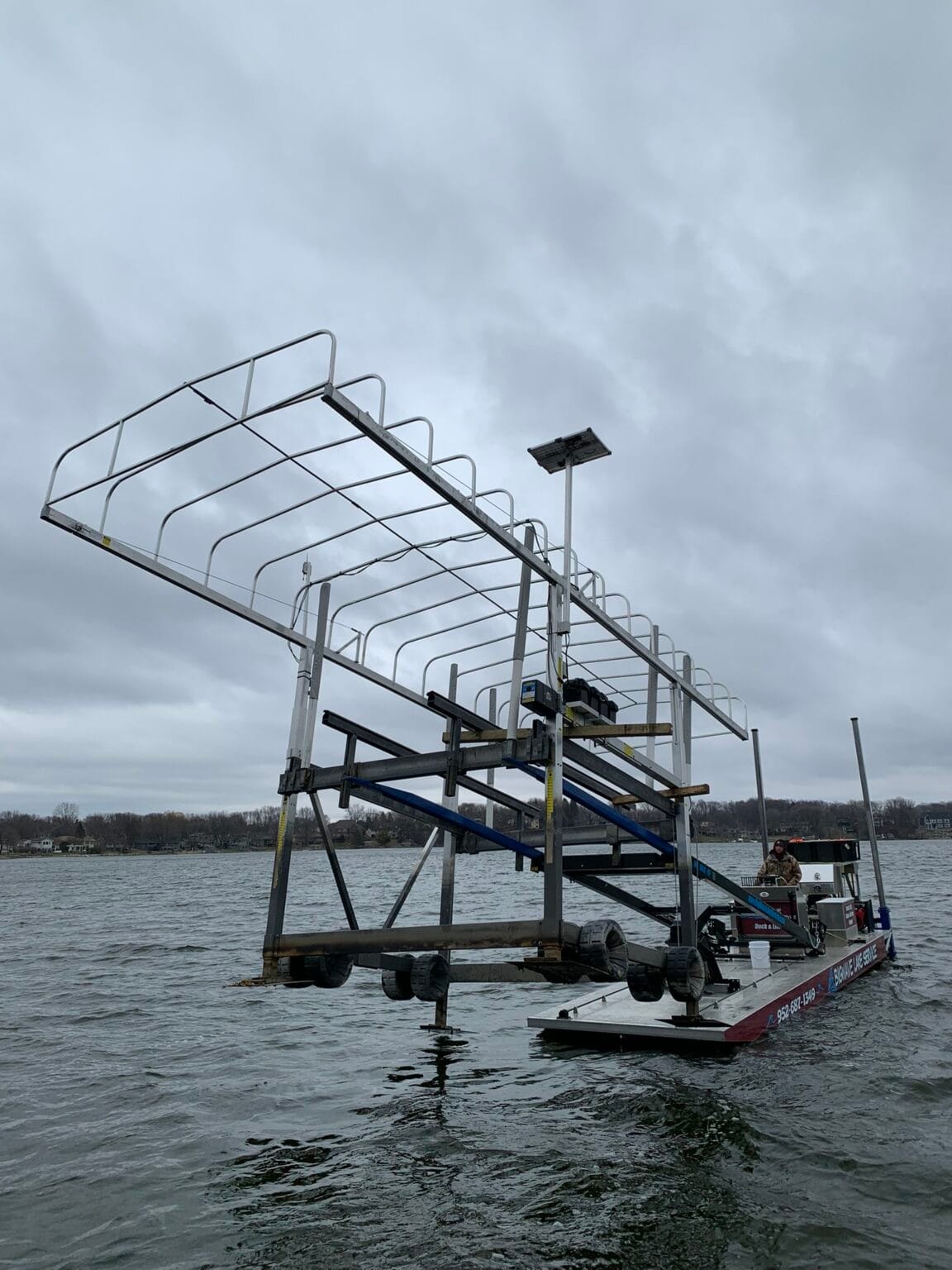
Docks and boat lifts
Can You Leave a Dock Over Winter in Minnesota?
Updated October 10, 2026
For most docks and boat lifts on south metro lakes, no. Leave a dock over winter and it sits in ice that expands, grips the legs and shoves with the wind, and ShoreMaster voids its dock warranty when a dock is exposed to ice. BigWave Lake Service pulls docks and lifts every fall.
Ice pushes hard. A Minnesota DNR article puts the force of expanding lake ice at “probably not less than 30,000 pounds per square foot.”
Leave it in or pull it: check your setup
Pick what you have and where it sits. Your answer updates as you pick.
Your answer
Pull it
Legs frozen into moving ice get jacked and bent. Roll-in and sectional docks are built to come out each fall.
This check needs JavaScript. In short: pull it, unless it is a floating dock in a protected cove.
01 / Ice
What ice does to a dock over winter
Cold alone does little harm. Moving ice does the damage, in three ways.
Point at a card to see what it does. On a phone, tap it.
Lake ice grows and shrinks with the temperature, pushing on anything frozen into it. The Minnesota DNR says it can shove up ridges “as high as five feet or more.”
Ice grips the legs. When the water level rises or drops, it drags them along, and the dock comes out bent or out of level.
At breakup, wind drives loose ice sheets along the shore. The DNR says these pile-ups are most common on larger lakes.
The damage often hides until spring, when a section sits crooked. Then it is a dock and lift repair and leveling job.
02 / Boat lifts
Why boat lifts should come out for winter
ShoreMaster puts it plainly: “Removing your boat lift from the water is the most effective way to prevent winter damage from ice and freezing conditions.”
Ice pushes the frame
A lift stands in the same moving ice as a dock, and spring ice floes push on the whole frame.
Hydraulic parts come off
A removable hydraulic lift has a pump box and battery to disconnect before winter.
Fall is service time
Screw jack legs, the threaded legs that raise and level the lift, need cleaning and grease every year or two, depending on your lake’s water quality and zebra mussels.
03 / De-icers
What de-icers and bubblers can and can’t do
They help on some docks, not all.
Point at a line to see the detail. On a phone, tap it.
What they can do
A de-icer is a propeller motor that pushes warmer water up from the bottom. A bubbler does it with air.
That is the minimum depth common propeller units list. A half-horsepower unit starts around $1,000, before you run power to the dock.
What they can’t do
The Lake Minnetonka Conservation District (LMCD) issues no new de-icing licenses for residential docks. Check with the DNR and your city first.
Open water is a thin-ice hazard.
04 / Permanent docks
Permanent docks and lake rules
A dock on pilings or rock cribs can’t come out, so it sits in the ice every winter.
More ice damage
The Minnesota DNR prefers removable docks because “permanent structures are more likely to sustain ice damage.”
A permit on Minnetonka
On Lake Minnetonka, a dock on machine-driven pilings needs an LMCD permit.
Weighing permanent against removable? See shoreline and layout help for a new dock and Minnesota DNR rules for docks and lifts.
05 / Questions
Winter dock and lift questions
When should a dock come out in Minnesota?
After your last fall boat ride and before the lake starts to freeze, so book early. With BigWave’s standing seasonal service, you get automatically reminded at the right time.
What does fall removal cost?
At Blake’s rates, docks run $4.50 a foot for 4-foot-wide sections and $5.75 for 5-foot, with a $200 minimum. Boat and pontoon lifts run $200 to $275 by capacity. Some things can’t be seen up front, so the price lands right on or very close. Photos of your dock help.
Get your dock and lift out of the water this fall
Talk with a BigWave specialist. We look at your shoreline and equipment, then give you options and prices. The owner is on every job.